Belles-Faire
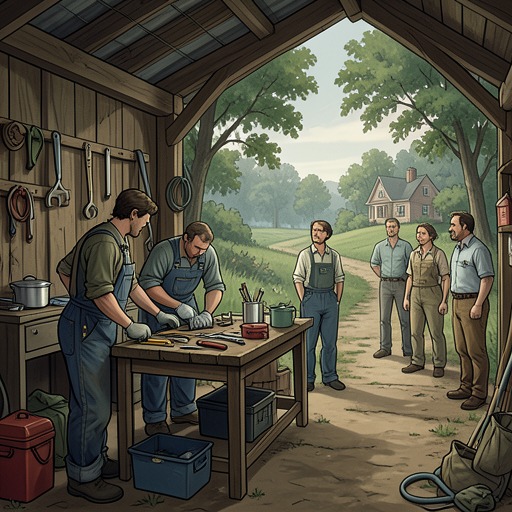
Tales From Otherworld: Collection OneBelles-Faire is the D’Artigo household’s Earthside home and one of the book’s most important lived environments. It is not merely a backdrop for supernatural events: its kitchens, gardens, greenhouse, paths, pond, fire pit, and surrounding woodland organize daily labor, emotional recovery, ritual practice, family care, and encounters with the dead. The location repeatedly turns ordinary domestic space into a threshold where human, magical, animal, seasonal, and ancestral forces meet.
Household and Material Setting
Belles-Faire is outside the main trash-collection route, so the household must remove its own garbage and carry it to the dump. This practical inconvenience places maintenance directly in the hands of the people who live there, making domestic survival a collective responsibility rather than an invisible service. The home also contains an herb garden and a greenhouse added to Iris’s cottage. Kitchen herbs have been moved into the greenhouse, while Camille D’Artigo’s magical herbs remain in the protective magical circle where they were planted until harvest. The distinction between ordinary culinary plants and magically constrained ones gives the property two overlapping systems of care: one domestic and productive, the other governed by magical conditions.
The grounds require seasonal preparation as well. In October, the herb garden is becoming ragged around the edges, and Camille D’Artigo thinks about composting the perennials before the rainy season arrives, since the coming chill and first frost could damage them. These details make Belles-Faire an active ecological setting whose inhabitants must read weather, soil, plant cycles, and seasonal change. The household’s future plans include deciding what must be repaired or replaced before the rainy season, particularly as Iris approaches the birth of her twins and Camille D’Artigo is expected to assume more responsibility for running the place.
Paths, Memory, and Refuge
A path leads from the backyard toward Birchwater Pond, a place Camille D’Artigo associates with calm. When anger at Trillian’s abrupt departure and frustration at repeatedly being treated as the household’s fallback person become overwhelming, she leaves through the back door and walks toward the pond. Along the route she passes the site where Hyto once captured her, and the place still triggers an involuntary shudder and a flood of unwanted memories.
The household has deliberately altered that painful site. Smoky and the other men cut down the trees that Hyto’s father had blasted, and rose bushes were planted in their place. The roses bloom well into autumn, their spicy scent interrupting Camille D’Artigo’s distress and helping her breathe, pause, and continue. Trillian proposed the planting as an attempt to replace destructive memories with something beautiful. The gesture does not immediately erase the past, but the altered landscape gives Camille D’Artigo a sensory route from trauma toward composure. By the time she reaches the opening near Birchwater Pond, the walk has calmed her.
Belles-Faire therefore holds contradictory memories in the same physical terrain. It contains the trace of captivity, but also the deliberate work of repair; it is a household that shelters its residents while requiring them to maintain, protect, and reinterpret the land around it. The path is both a practical route and a recurring emotional passage from domestic pressure into a wider space where Camille D’Artigo can regain control of herself.
Birchwater Pond and Seasonal Ritual
Near Birchwater Pond, the household has built picnic tables, benches, a covered shelter, and a fire pit. The facilities allow the residents to gather outdoors for rituals and holidays even when the weather is poor, giving the pond a communal and ceremonial function beyond recreation. On a clear, cool mid-October evening, leaves leave the trees in the wind and stars fill the sky above the flames. The setting joins ordinary leisure with the autumnal supernatural order.
The pond is especially significant to Delilah D’Artigo and Shade. Shortly before Autumn Whispers, they seek privacy there rather than remaining in their rooms, sitting beside the bonfire and roasting marshmallows. Delilah D’Artigo fingers the smoky quartz ring Shade gave her, noting that it has become inseparable from her nature and binds her to him in ways she does not yet fully understand. Their shared food, fire, and secluded setting establish intimacy through domestic gestures, while the ring materializes a deeper magical and relational bond.
The evening also makes the pond a site of seasonal power. Autumn is described as the season of Hi’ran, and Delilah D’Artigo feels his presence in the trees, flames, and chilled air. Hi’ran appears as a great shadow of fire and smoke, while the Harvestmen remain alert because something is developing in the world. The pond’s shelter and fire pit thus support both family ritual and supernatural vigilance: the same landscape offers privacy to lovers and signals the approach of danger.
Thresholds and Supernatural Encounters
The grounds around Belles-Faire can shift without warning from familiar domestic space into a supernatural threshold. As Camille D’Artigo approaches the pond at dusk, she sees unexpected lights flickering from the grotto. The household’s picnic structures are meant for rituals and holidays, but no one should be there at that time of year. She considers whether the lights might be eye catchers or will-o’-the-wisps, possibilities that range from mischievous to highly dangerous, before hearing music from an MP3 player and recognizing that the presence is not simply an infestation of magical pests.
The property also receives visitors who cross the boundary between life and death. In Hanna’s bedroom, Maggie lies asleep in her crib while a faint shimmer appears near the bed. A bear floats out of Hanna’s hand and through the air, eventually settling beside the child. The apparition is a large, doe-eyed woodland gargoyle with calico fur resembling Maggie’s. She leans over the crib, smiles and nods when Camille D’Artigo identifies her as Maggie’s dead mother, and accepts the household’s assurance that Maggie is being cared for as well as possible.
The encounter transforms the home into a place where family continuity survives death. Maggie’s mother reaches down with a ghostly hand to stroke Maggie’s face; the sleeping child giggles softly and hugs her bear without waking. Before departing, the apparition gives the household a final look in which sadness is mixed with relief and tears of joy. Belles-Faire is consequently more than a protected residence for the living: it is a space where absent relatives can briefly return, witness the care being given to a child, and find reassurance.
Narrative Significance
Belles-Faire gathers the book’s central tensions into one location. It is a working household with garbage to haul, herbs to protect, gardens to prepare, and repairs to plan, yet it is also a magical compound exposed to seasonal powers, dangerous memories, ritual forces, and visitations from the dead. Its material arrangements make care visible: food, plants, shelter, memory, children, and relationships all require ongoing attention.
The location also complicates the boundary between nature and domesticity. Living animals disrupt ordinary expectations, as when Smoky brings a still-living turkey into the kitchen instead of purchasing a prepared bird. Plants remain subject to magical circles and weather, while the pond, trees, flames, and autumn air become active participants in ritual atmosphere. At Belles-Faire, the household does not master its environment completely; it negotiates with living matter, seasonal change, magical rules, and forces that can enter from beyond the visible world.
Its deepest narrative function is therefore connective. The home links domestic labor to emotional resilience, ecological stewardship to magical practice, romance to ritual, and family care to the continuing presence of the dead. Belles-Faire gives the D’Artigo household a place to retreat, argue, prepare, remember, and receive signs that the larger supernatural world is moving around them.